Full Spectrum vs Broad Spectrum vs CBD Isolate
Which extract type is for what.
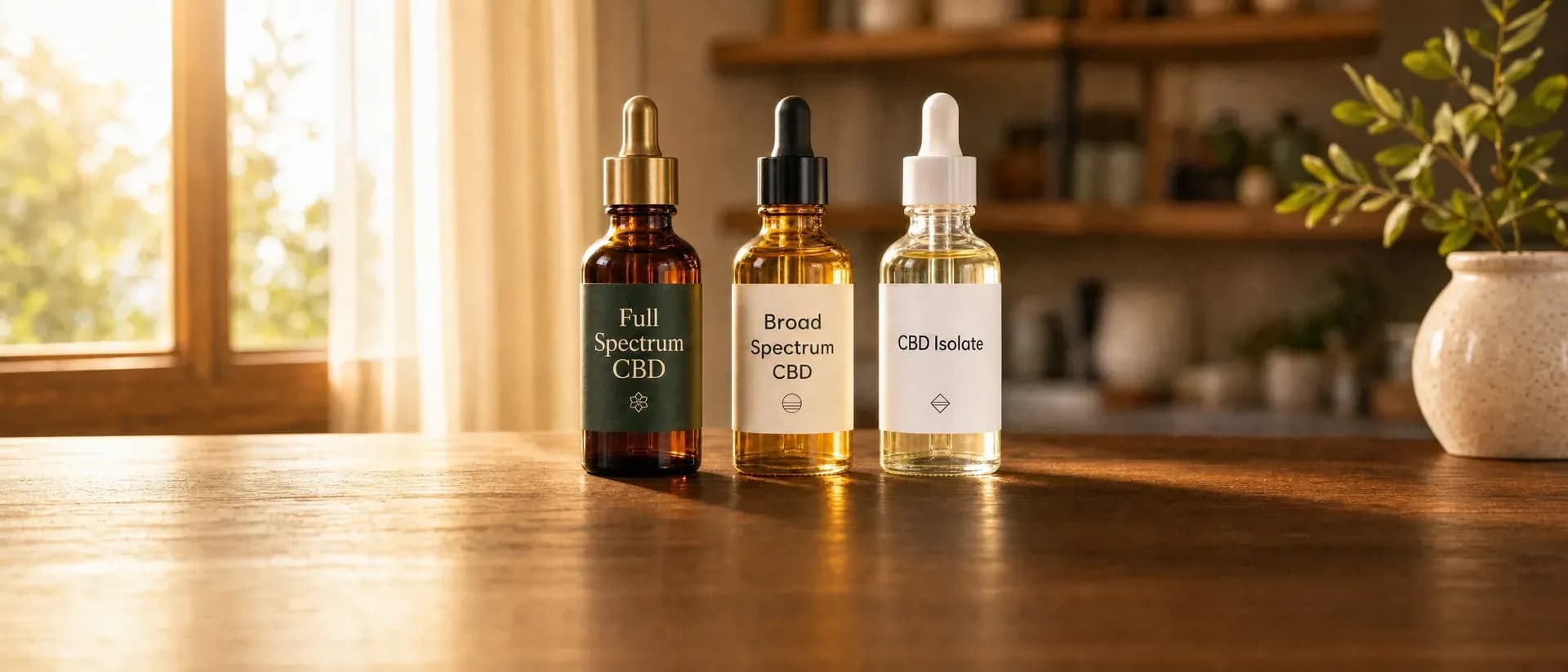
The difference between the three is how much of the plant survives processing.
| Type | What it contains | THC |
|---|---|---|
| Full spectrum | The plant’s whole cannabinoid and terpene profile | Trace amounts below the legal threshold |
| Broad spectrum | Cannabinoids and terpenes with THC removed | None detectable |
| Isolate | Purified cannabidiol, around 99% | None |
The entourage effect
The idea that cannabinoids and terpenes interact, and that the whole plant behaves differently from an isolated compound, is known as the entourage effect. It was put forward in 1998 by Ben-Shabat and Mechoulam and has been studied since.
Where it stands today matters: the hypothesis has preclinical support but is not established as a proven effect in humans, and it is not a basis for a health claim. So we describe it as a hypothesis, not as a product advantage.
When each makes sense
Full spectrum
- CBD per 0.5 ml serving
- 100 mg
- Other cannabinoids
- CBG, CBC, CBN — traces
- THC
- Below the legal thresholdnot zero
- Terpenes
- Retained
- Taste
- Pronounced, plant-like
- Before a drug test
- Not the first choice
Broad spectrum
- CBD per 0.5 ml serving
- 100 mg
- Other cannabinoids
- CBG, CBC, CBN — traces
- THC
- None detectable
- Terpenes
- Partly retained
- Taste
- Milder
- Before a drug test
- Suitable
Isolate
- CBD per 0.5 ml serving
- 100 mg
- Other cannabinoids
- None
- THC
- None
- Terpenes
- None
- Taste
- Neutral
- Before a drug test
- Suitable
Continue learning

Sources & references
Every factual statement above rests on the documents listed. Check them yourself.
- Ben-Shabat S. et al. An entourage effect. Eur J Pharmacol, 1998https://pubmed.ncbi.nlm.nih.gov/9721036/
- Russo E.B. Taming THC: potential cannabis synergy. Br J Pharmacol, 2011https://pubmed.ncbi.nlm.nih.gov/21749363/
- Regulation (EC) No 1924/2006 on health claimshttps://eur-lex.europa.eu/legal-content/BG/TXT/?uri=CELEX%3A32006R1924