How to Read a CBD Lab Report (COA)
Checking potency, purity and safety.
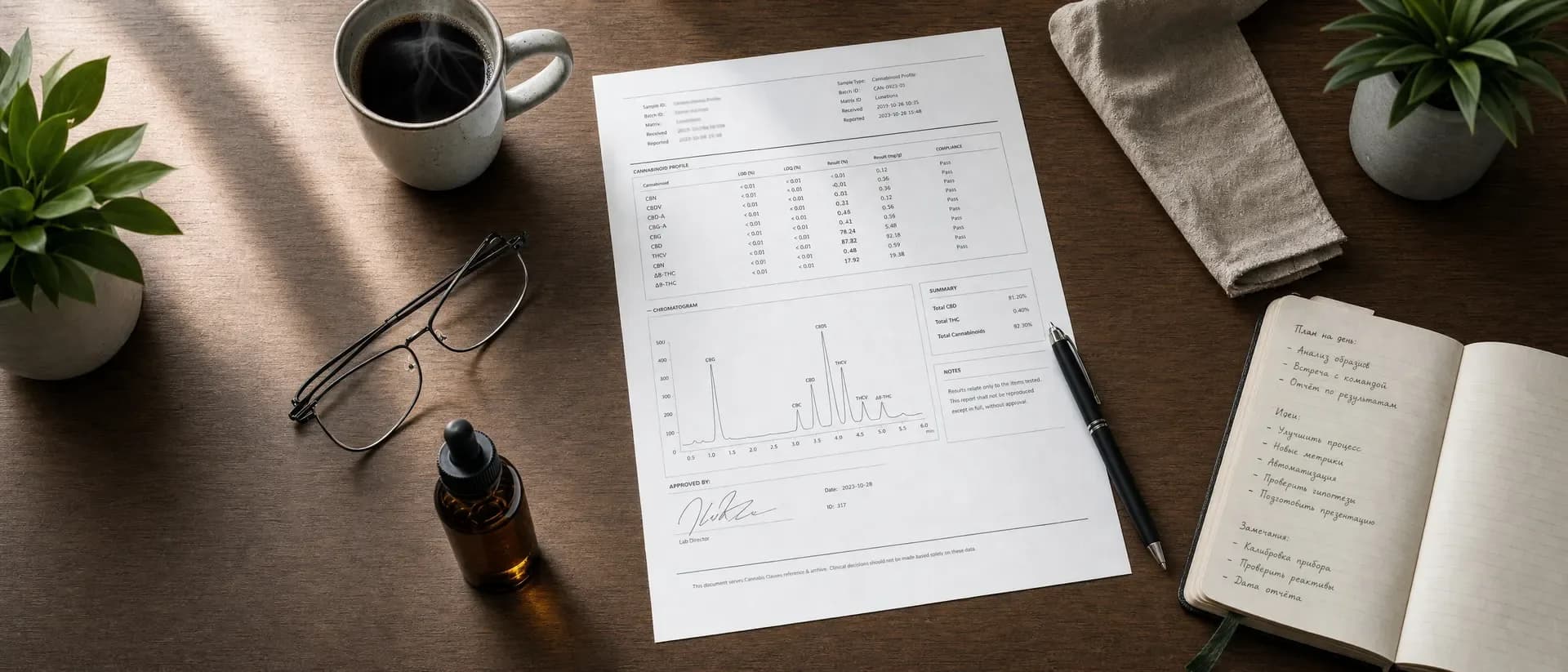
A COA (Certificate of Analysis) is an independent laboratory’s report on one batch. It is the only way to check that the label tells the truth.
First: is it your batch
The most important check is the dullest one. The batch number on the report must match the packaging, and the test date should sit close to the production date. A report "for the product in general" proves nothing about the bottle in your hand.
The cannabinoid profile
- CBD — the measured amount should match the label within a reasonable tolerance.
- THC and delta-9-THC — below the legal threshold.
- CBDA, CBG, CBN — their presence tells you what kind of extract this is.
- LOQ / ND — "below the limit of quantification" or "not detected".
Safety testing
A full analysis does not stop at cannabinoids. Hemp draws from the soil it grows in, so it is also tested for:
- heavy metals — lead, cadmium, mercury, arsenic;
- pesticide residues;
- residual solvents from extraction;
- microbiology and mycotoxins.
Frequently asked questions
Quick answersWho performs the analysis?
It matters that the laboratory is independent of the producer, and preferably accredited to ISO/IEC 17025. The laboratory’s name and accreditation appear on the report itself.
Continue learning

Sources & references
Every factual statement above rests on the documents listed. Check them yourself.
- ISO/IEC 17025 — requirements for testing laboratorieshttps://www.iso.org/standard/66912.html
- Regulation (EC) No 1881/2006 — maximum levels for contaminantshttps://eur-lex.europa.eu/legal-content/BG/TXT/?uri=CELEX%3A32006R1881
- Regulation (EC) No 396/2005 — maximum residue levels of pesticideshttps://eur-lex.europa.eu/legal-content/BG/TXT/?uri=CELEX%3A32005R0396